
Misdemeanors in Illinois are classified as Class A, Class B, and Class C offenses. The classification can affect the range of possible penalties, but the consequences of an individual case depend on the specific offense, the facts involved, criminal history, and how the case is resolved.
A misdemeanor is less serious than a felony, but that does not mean it is harmless. Even a lower-level criminal charge may affect a person’s record, employment, professional licensing, immigration status, or other parts of their future.
What Is a Misdemeanor in Illinois?
A misdemeanor is a criminal offense that Illinois law treats differently from a felony and is generally subject to lower potential penalties. Illinois law divides misdemeanors into three primary classes: Class A, Class B, and Class C.
Depending on the offense and case outcome, a misdemeanor can involve:
- jail time;
- fines;
- probation or court supervision;
- court-ordered classes, counseling, or treatment where applicable;
- a criminal record; and
- consequences outside the courtroom.
The classification tells you the general penalty category of the charge. It does not tell you exactly what sentence you will receive or whether your case will result in a conviction.
That distinction matters for someone facing a misdemeanor for the first time. The statutory maximum may sound intimidating, but sentencing alternatives and other resolutions may be available depending on the charge and circumstances.
Misdemeanor cases can also have consequences beyond jail or fines. Depending on the offense and disposition, a misdemeanor case may also have consequences involving employment screening, professional licensing, housing, immigration, or firearm eligibility.
Misdemeanors in Illinois: Class A, B, and C Explained
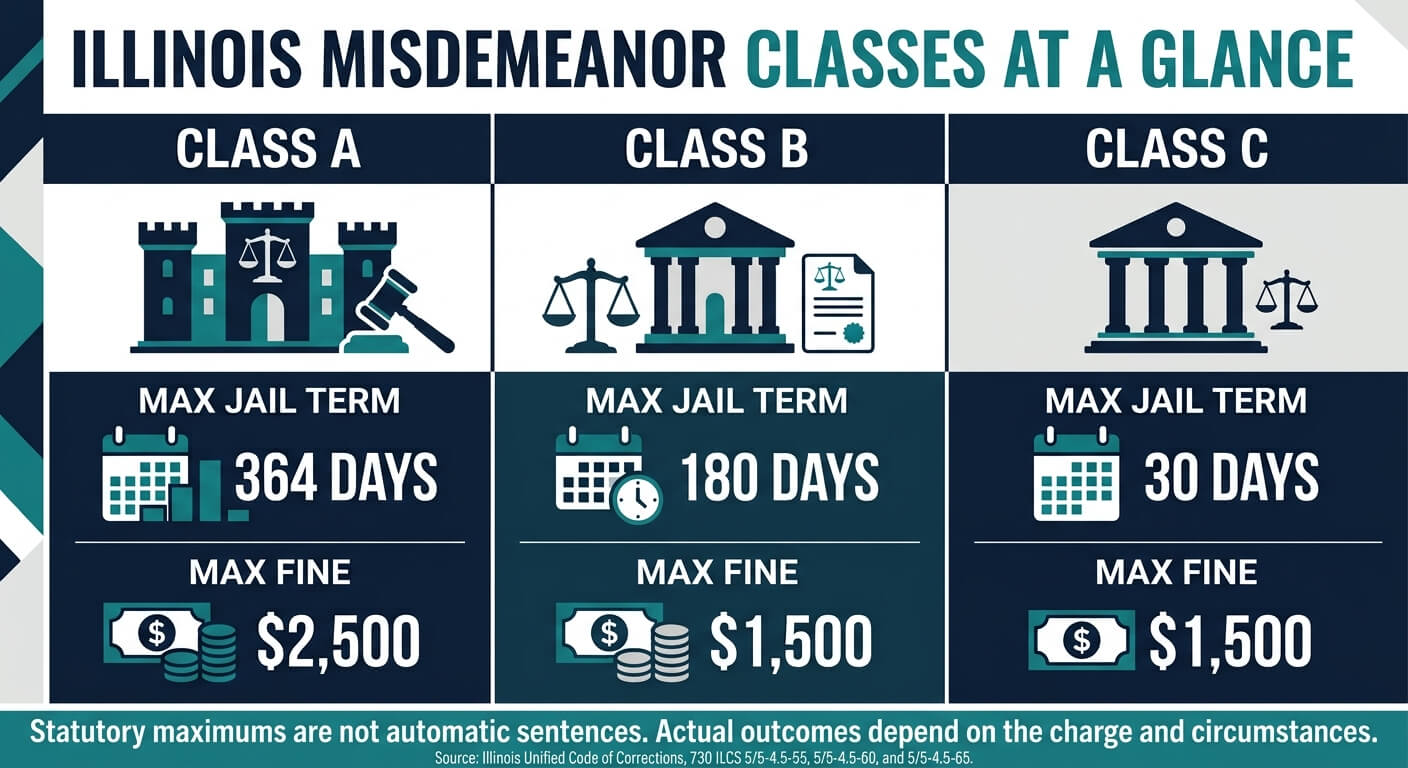
Illinois misdemeanor classes have different maximum penalty ranges. Class A is the most serious misdemeanor category, followed by Class B and then Class C.
Illinois Misdemeanor Chart
| Misdemeanor Class | Maximum Jail Time | Maximum Fine |
|---|---|---|
| Class A |
Up to 364 days | Up to $2,500 |
| Class B |
Up to 180 days | Up to $1,500 |
| Class C |
Up to 30 days | Up to $1,500 |
Sources: Illinois Unified Code of Corrections, 730 ILCS 5/5-4.5-55, 5/5-4.5-60, and 5/5-4.5-65.
These figures reflect the statutory maximum jail terms and fines for each Illinois misdemeanor class. They are not automatic sentences, and Illinois law can change.
The actual outcome of a case depends on the charge, facts, criminal history, and available dispositions.
What the Misdemeanor Class Tells You—and What It Does Not
The misdemeanor class helps identify the maximum penalty range associated with an offense.
It does not automatically tell you:
- whether you will go to jail;
- whether probation, court supervision, or another alternative disposition is legally available;
- whether the charge can be reduced or dismissed;
- whether you will have a conviction;
- or whether the record can later be sealed or expunged.
Two people charged with offenses in the same misdemeanor class can have very different case outcomes.
What Is a Class A Misdemeanor in Illinois?
A Class A misdemeanor is the most serious misdemeanor classification in Illinois. It carries greater potential jail exposure than a Class B or Class C misdemeanor.
A Class A misdemeanor may be punishable by up to 364 days in jail and a fine of up to $2,500, subject to the law governing the particular offense and case.
Class A Misdemeanors in Illinois: Common Charges
Depending on the circumstances, offenses that may be prosecuted as Class A misdemeanors include:
- a first DUI without felony-enhancing circumstances;
- domestic battery in certain cases;
- battery;
- certain retail theft offenses; and
- other offenses specifically classified as Class A misdemeanors under Illinois law.
The same general type of offense can sometimes be charged differently depending on factors such as prior convictions, the conduct alleged, injuries, property value, or other aggravating circumstances.
For that reason, someone should not assume that an offense is automatically a misdemeanor simply because another person faced a misdemeanor charge for similar conduct.
What Can Happen After a Class A Misdemeanor Charge?
The potential consequences can extend beyond the maximum jail term.
Depending on the offense and final disposition, possible consequences may include:
- jail exposure;
- fines;
- probation or court supervision where legally available;
- court-ordered education, counseling, treatment, or community service;
- driver’s license consequences for some offenses; and
- other consequences tied to the particular conviction or disposition.
A Class A misdemeanor can carry jail exposure, but being charged does not mean a person will automatically be sentenced to jail. A court may consider the offense, criminal history, aggravating and mitigating facts, and available sentencing alternatives before imposing a sentence.
What Is a Class B Misdemeanor in Illinois?
A Class B misdemeanor falls below Class A but above Class C in Illinois’s misdemeanor classification system.
A Class B misdemeanor may carry up to 180 days in jail and a fine of up to $1,500.
Class B Misdemeanor Examples
Certain criminal trespass offenses and other lower-level criminal violations may fall within the Class B category, depending on the statute and facts.
The important point is that a Class B misdemeanor is still a criminal charge. A person should not assume that the case is insignificant simply because it carries less possible jail time than a Class A misdemeanor.
Someone facing a Class B charge may focus first on whether incarceration is possible. The longer-term effect of the case disposition can be just as important.
A conviction may matter later when a person applies for certain jobs, licenses, housing, or other opportunities that involve criminal-history screening.
What Is a Class C Misdemeanor in Illinois?
A Class C misdemeanor is the lowest misdemeanor classification in Illinois, but it is still a criminal offense.
A Class C misdemeanor may carry up to 30 days in jail and a fine of up to $1,500.
Simple assault and some forms of disorderly conduct may be classified as Class C misdemeanors, depending on the particular statute and circumstances.
Because the maximum penalties are lower, people sometimes assume a Class C misdemeanor is little more than a ticket. That can be a costly misunderstanding.
A Class C conviction may still create a criminal record and may appear in background-check contexts unless the record later qualifies for and receives appropriate relief.
Is a Petty Offense the Same as a Misdemeanor in Illinois?
Illinois law distinguishes petty offenses from criminal misdemeanors. The exact consequences and classification depend on the statute governing the particular offense.
A person should therefore not assume that a low-level ticket or citation is the same thing as a Class C misdemeanor simply because both may appear relatively minor.
Can You Go to Jail for a Misdemeanor in Illinois?
Yes. Illinois misdemeanors can carry jail time, although being charged with a misdemeanor does not mean a person will automatically be sentenced to jail.
The maximum jail exposure varies by class:
The sentence in an individual case can depend on several factors, including:
- the specific offense;
- previous convictions or criminal history;
- aggravating or mitigating circumstances;
- harm caused by the alleged conduct;
- compliance with existing court orders;
- eligibility for supervision, probation, or other alternatives; and
- how the case is resolved.
The maximum penalty is therefore only one part of the picture.
For a deeper explanation of how Illinois courts evaluate penalties, see our guide to Illinois sentencing guidelines and what determines your penalty.
First-Time Defendants May Have More Options
Someone facing their first criminal charge may have questions about whether jail can be avoided or whether the case can be resolved without a conviction.
Depending on the charge, jurisdiction, and eligibility, possible case outcomes or alternatives may include:
- court supervision;
- probation;
- diversion programs;
- deferred prosecution programs;
- counseling or treatment;
- anger-management programs;
- substance-use education; or
- negotiated resolutions.
Not every option is available in every case.
Eligibility may depend on the particular offense, criminal history, the prosecutor, the court, local program rules, and Illinois law.
For a first-time defendant, an important question is not simply, “Will I go to jail?” It is also, “What will this resolution mean for my record later?”
A disposition that avoids immediate incarceration may still have consequences that deserve careful consideration before a person agrees to it.
How Can a Misdemeanor Affect Your Criminal Record?
The effects of a misdemeanor do not necessarily end when the court case is over.
Depending on the offense and disposition, a criminal record may affect several parts of a person’s life.
Employment
Some employers use criminal background checks when hiring or promoting workers. What an employer can consider may depend on the type of job and applicable law.
Professional Licensing
People working in regulated professions may be required to disclose certain criminal cases or convictions to a licensing authority.
The consequences vary widely by profession and offense.
Housing
Criminal-history information may arise during some housing screening processes. The effect of that information depends on the circumstances and applicable housing laws.
Education and Professional Programs
Certain schools, internships, clinical programs, or professional training programs may ask applicants about criminal history.
Firearm Rights
Certain convictions or circumstances may affect firearm eligibility under state or federal law. A misdemeanor classification alone does not determine the answer; the particular offense and applicable state or federal law matter.
Immigration
Some criminal charges or dispositions may create immigration consequences for noncitizens, depending on the offense and the person’s immigration circumstances.
Importantly, immigration law does not always treat an offense according to whether Illinois labels it a misdemeanor or felony. The elements of the offense and the final disposition can matter.
For more information, see our guide to how criminal charges can affect immigration status in Illinois.
Can Illinois Misdemeanors Be Expunged or Sealed?
Some Illinois misdemeanor records may qualify for expungement or sealing, but eligibility depends on the offense and how the case ended.
Relevant factors can include:
- whether the case resulted in a conviction;
- whether court supervision was successfully completed;
- the specific offense;
- applicable waiting periods;
- prior or subsequent criminal history; and
- statutory exclusions.
Expungement and sealing are different forms of record relief under Illinois law. Which remedy may be available depends on the case outcome, offense, criminal history, waiting requirements, and statutory exclusions.
That makes the outcome of the original criminal case especially important. A resolution that seems acceptable today may affect the person’s record-clearing options later.
For a fuller explanation, see Expungement in 2026: Who Qualifies in Illinois?
How a Defense Lawyer May Help With a Misdemeanor Case
A misdemeanor charge may involve more than the maximum jail time or fine listed in a classification chart.
How the case is resolved can affect a person’s criminal record, employment, professional opportunities, driver’s license, immigration status, or eligibility for future record relief.
A criminal defense lawyer may review:
- whether prosecutors can prove each element of the charge;
- whether evidence was lawfully obtained;
- witness or identification problems;
- possible defenses;
- available motions;
- eligibility for supervision or other alternative resolutions;
- plea negotiations;
- possible sentencing consequences; and
- how different outcomes may affect the client’s record.
No lawyer can guarantee that a misdemeanor will be dismissed or reduced. The appropriate strategy depends on the charge, evidence, criminal history, and circumstances of the case.
Charged With a Misdemeanor in Illinois?
A misdemeanor may carry fewer potential penalties than a felony, but that does not mean the case should be ignored.
If you are facing a misdemeanor charge in Naperville or the surrounding area, John W. Callahan, Ltd. can review the circumstances, explain the possible consequences, and discuss the legal options that may apply to your case.
Misdemeanors Can Have Bigger Consequences Than They First Appear
Class A, B, and C misdemeanors in Illinois carry different potential penalty ranges, but the classification is only one part of understanding a criminal case.
The particular offense, available evidence, criminal history, sentencing alternatives, and final disposition can all affect what happens next. Understanding those issues early can help a defendant make more informed decisions about both the immediate case and its possible long-term consequences.
Facing a misdemeanor charge in Naperville?
Discuss the charge, possible consequences, and the legal options that may apply.