
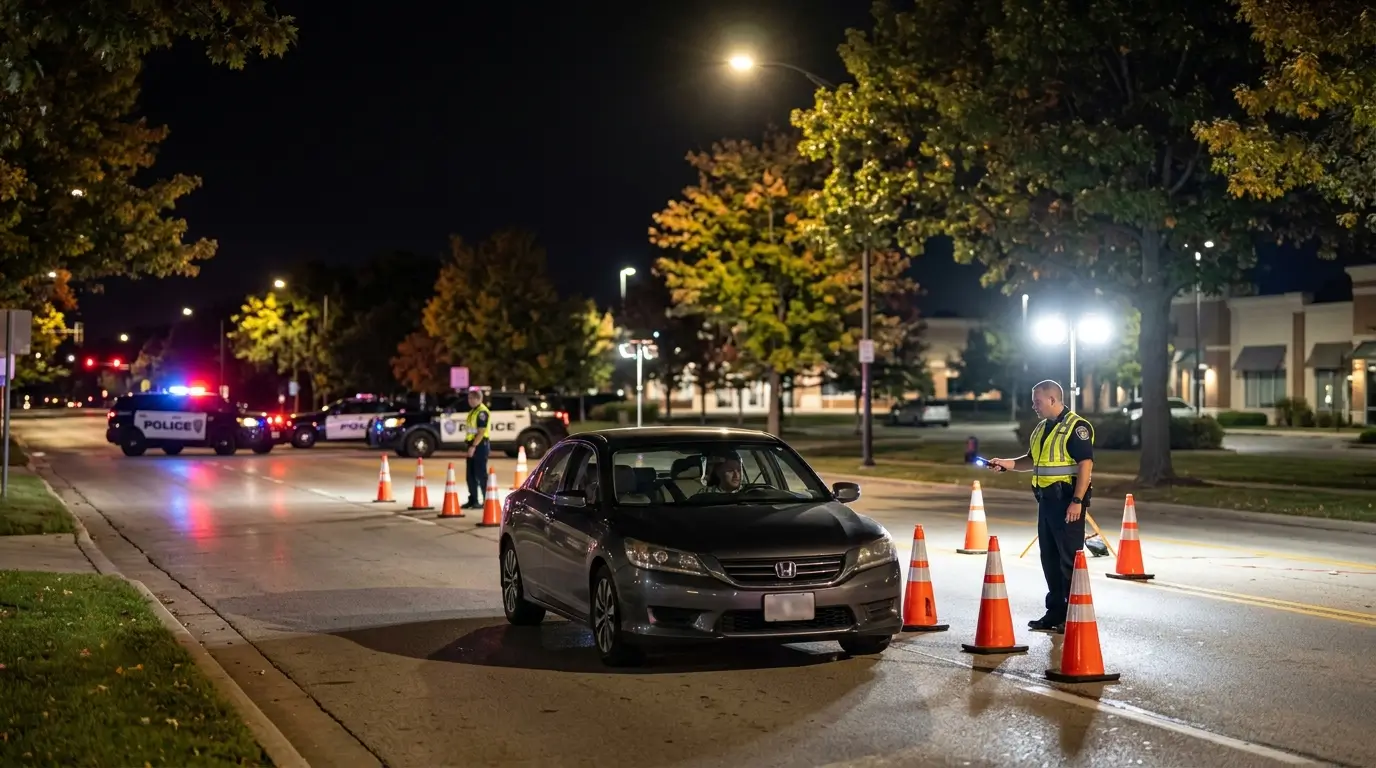
DUI checkpoints do not eliminate a driver’s legal protections. If you encounter a sobriety checkpoint in Naperville, police still must operate within applicable constitutional and Illinois-law limits, and what happens next depends on what occurs during the stop.
Fall weekends can bring football gatherings, festivals, Halloween events, and busier nightlife throughout Naperville and DuPage County. Those occasions may also coincide with impaired-driving enforcement efforts. For drivers, the important question is not simply whether police are watching for DUI offenses, but what officers may lawfully do during a checkpoint and what rights remain in place.
Why DUI Enforcement May Increase Around Fall Events
Fall events and busy nightlife periods may coincide with additional impaired-driving enforcement efforts.
Football weekends, Oktoberfest celebrations, Halloween parties, college events, community festivals, and late-night entertainment can all put more drivers on the road after events where alcohol is available. Depending on the agency and event, enforcement may involve ordinary patrols, targeted DUI patrols, or sobriety checkpoints.
Those approaches are not the same.
A DUI checkpoint involves officers stopping vehicles according to an established checkpoint plan. A saturation patrol or ordinary traffic patrol generally involves officers watching for traffic violations or signs of impaired driving while moving through a particular area.
Naperville and DuPage County drivers should therefore avoid assuming that every fall DUI enforcement campaign involves a checkpoint. The exact strategy can vary by agency, date, event, and location.
Are DUI Checkpoints Legal in Illinois?
Sobriety checkpoints may be lawful in Illinois when they comply with applicable constitutional and state-law requirements.
Whether a particular checkpoint is lawful can depend on how it was planned, operated, and applied to individual drivers.
Courts may look at issues such as how the checkpoint was planned, how vehicles were selected for stopping, how much discretion individual officers had, how long drivers were detained, and whether officers had a lawful reason to extend an initial encounter.
That means a checkpoint is not automatically lawful simply because officers call it a DUI checkpoint.
Likewise, a driver cannot assume that every stop made at a checkpoint is unconstitutional. The legality usually depends on how the checkpoint was established and how the individual stop unfolded.
What Makes DUI Checkpoints Lawful in Illinois?
A lawfully operated checkpoint generally uses procedures intended to limit arbitrary officer discretion.
For example, officers may follow a predetermined pattern for stopping vehicles rather than deciding on the spot which drivers appear worth investigating. Safety precautions, supervisory planning, traffic conditions, and the duration of the initial stop may also become relevant when the checkpoint is reviewed.
What Happens During a DUI Checkpoint Stop?
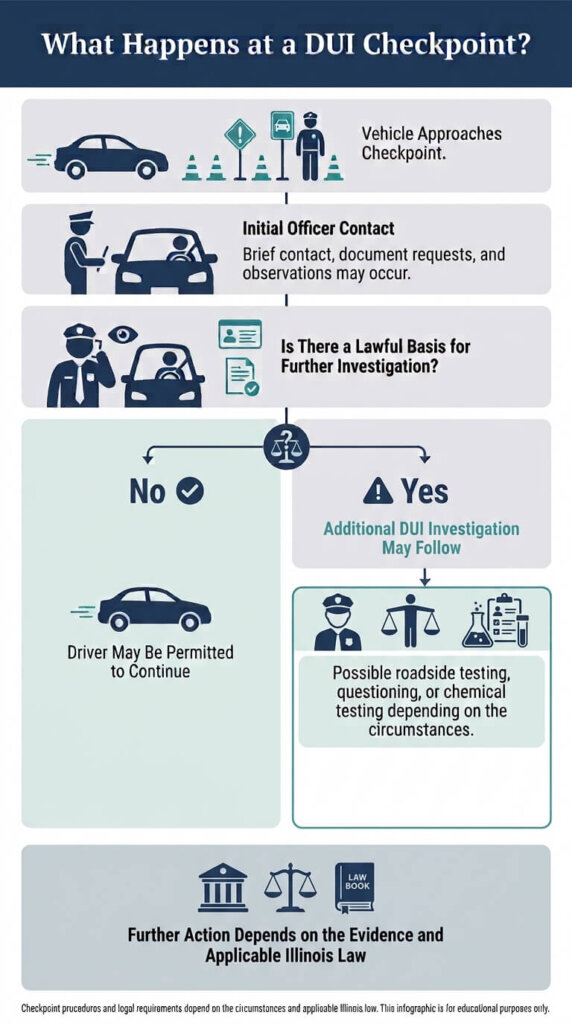
A checkpoint encounter generally begins as a brief screening stop.
An officer may direct a vehicle into the checkpoint, make contact with the driver, request legally required driving documents, and observe the driver and vehicle. The officer may also ask questions.
The encounter can then move in one of two general directions.
If the officer does not identify a lawful reason for further investigation, the driver may be permitted to continue. If the officer observes facts that raise concerns about possible impairment or another violation, the driver may be directed to a secondary area for additional investigation.
That distinction matters.
The initial checkpoint stop and an extended DUI investigation are not necessarily the same legal event. The longer the detention continues, the more important it becomes to identify what facts allegedly justified additional questioning, testing, or investigation.
What Rights Do Drivers Have at a DUI Checkpoint?
At DUI checkpoints, drivers retain constitutional rights, but those rights exist alongside legal obligations that may apply to anyone operating a motor vehicle.
Understanding the difference between required compliance and voluntary cooperation is especially important.
License, Registration, and Required Documents
Illinois drivers may be required to provide a valid driver’s license and other legally required vehicle documentation during a lawful traffic encounter.
A person should not assume that the right to remain silent means they can refuse every lawful request connected with identifying the driver or vehicle.
The more complicated questions involve what happens after those basic requirements have been satisfied.
Questions About Drinking
An officer may ask where a driver has been, where they are going, or whether they consumed alcohol.
Those questions can be investigative.
Drivers should understand that providing legally required identification is different from volunteering detailed information about activities that could become part of a criminal investigation.
What a driver is legally required to answer can depend on the circumstances, so broad rules such as ‘you never have to answer police questions’ can be misleading.
Requests to Search the Vehicle
A police officer may ask for permission to search a vehicle.
A request for consent is different from a search conducted under another recognized legal basis. Declining voluntary consent does not necessarily mean police can never conduct a search, but a driver does not automatically surrender constitutional protections merely because the encounter occurs at a DUI checkpoint.
Whether a particular search was lawful depends on the facts and the legal basis officers relied upon.
Asking Whether You Are Free to Leave
A driver may ask whether the checkpoint interaction is complete and whether they are free to leave.
That question does not automatically end the encounter. Whether the driver can leave depends on the stage of the stop and whether officers have a lawful basis to continue detaining the person.
For a broader discussion of police questioning, see Should You Talk to Police Without a Lawyer?
Can You Legally Turn Around Before a DUI Checkpoint?
A driver should not commit a traffic violation simply to avoid a checkpoint.
A lawful turn made before reaching a checkpoint may raise different legal issues from an illegal U-turn, unsafe maneuver, abrupt lane change, or other traffic offense.
Officers may also monitor roads leading toward or away from a checkpoint. A separate traffic violation or unsafe maneuver may give police another legal basis to initiate a stop.
The fact that someone altered their route does not automatically establish impaired driving. Whether police have a lawful basis for a stop can depend on the driver’s actions, the surrounding facts, and applicable Illinois law.
Drivers should continue to obey traffic laws rather than making an illegal or unsafe maneuver to avoid a checkpoint.
Field Sobriety Tests at DUI Checkpoints
If an officer develops concerns about possible impairment, the encounter may progress to field sobriety testing.
Common roadside sobriety tests may include eye-movement testing, the walk-and-turn test, and the one-leg stand test.
These tests are designed to give officers observations that may become part of a DUI investigation.
They are not performed in a laboratory. Roadside circumstances can therefore become relevant when the results are evaluated.
Weather, lighting, pavement conditions, footwear, fatigue, anxiety, injuries, balance problems, neurological conditions, and the way instructions were given may all affect how a person performs.
The more accurate way to describe these tests is not simply to call them “subjective.” These tests are generally administered according to established procedures, but officer observations, test administration, physical conditions, and environmental factors may still become relevant when the evidence is reviewed.
What About Breath Testing at a DUI Checkpoint?
Breath testing can raise a separate set of legal questions.
Different types of alcohol testing can occur at different stages of a DUI investigation, and the legal rules or consequences may not be the same for each one.
That is why broad advice such as “always refuse a breath test” or “you must always take the test” can be misleading.
The driver’s situation, the type of test, the stage of the investigation, and Illinois implied-consent rules can all matter.
Anyone arrested for DUI should have the specific testing sequence reviewed carefully, including what test was requested, what warnings were given, how the equipment was used, and what consequences followed.
What Happens After a DUI Arrest at a Checkpoint?
A checkpoint DUI arrest can create two related but distinct legal concerns: the criminal DUI case and possible driver’s-license consequences.
An arrest does not mean the driver has been convicted.
After an arrest, the case may involve processing, a criminal charge, court appearances, review of test results, and questions about the driver’s license. Depending on the circumstances and applicable Illinois law, additional driving restrictions or license-related requirements may also become relevant.
License issues can operate under rules that are separate from the ultimate outcome of the criminal DUI prosecution.
That distinction is easy to miss. A person may focus entirely on the criminal charge while overlooking a separate deadline or procedure related to driving privileges.
For a more detailed discussion of what follows a first DUI arrest, see Facing a First-Time DUI in Naperville? Here’s What You Need to Know.
What Issues Can a Lawyer Review After a Checkpoint Arrest?
A checkpoint arrest is not automatically valid simply because the stop occurred as part of an organized DUI enforcement effort.
A defense lawyer may review several different stages of the encounter.
- Checkpoint procedures. Counsel may examine how the checkpoint was planned, how vehicles were selected, what discretion officers had, and whether the operation complied with applicable law.
- Additional detention. The initial checkpoint contact may have been brief, but the lawyer can examine what facts officers relied upon when extending the stop into a DUI investigation.
- Field sobriety testing. Police reports and video may help show how tests were explained, where they were performed, what conditions existed, and what the driver actually did.
- Breath or chemical testing. The type of test, equipment, procedures, warnings, and timing may all require review.
- Officer observations. Descriptions such as odor of alcohol, speech, balance, eye appearance, or driving behavior should be evaluated alongside available video and other evidence.
- Constitutional issues. Questions may arise about detention, searches, questioning, or other police actions.
The presence of one of these issues does not automatically mean the charge will be dismissed. The purpose of the review is to evaluate whether the evidence and police procedures support the charge under applicable law.
How Can a Naperville DUI Lawyer Help?
A DUI case can involve more than what happened during the few minutes a driver spent at the checkpoint.
A Naperville DUI lawyer may obtain police reports, request available video, review field sobriety tests, examine breath or chemical-test evidence, evaluate checkpoint procedures, and address driver’s-license issues.
A lawyer can also explain how the criminal case and any administrative license consequences interact and identify deadlines that may matter.
In some cases, the evidence may support legal challenges or negotiations. In others, the most important role of counsel may be helping the driver understand realistic options and avoid decisions based on incomplete information.
No defense lawyer can promise that a DUI charge will be dismissed, that a license will be preserved, or that a particular outcome will occur.
The appropriate strategy depends on the facts and evidence in the individual case.
Stopped or Arrested at a DUI Checkpoint in Naperville?
A checkpoint arrest can raise questions about the legality of the stop, roadside testing, chemical testing, and driver’s-license consequences.
If you were arrested after a DUI checkpoint or other impaired-driving investigation in Naperville or DuPage County, John W. Callahan, Ltd. can review the circumstances and explain the legal issues that may apply to your case.
Knowing What Happened at the Checkpoint Matters
A DUI checkpoint does not eliminate a driver’s legal rights, and an arrest does not establish guilt.
How the checkpoint was operated, why the stop was extended, what officers observed, how field sobriety or chemical testing was performed, and what video or other evidence shows may all affect the case.
For someone facing a DUI charge, understanding those facts is a more useful first step than assuming the checkpoint itself determines the outcome.
Stopped or arrested during a DUI investigation in Naperville?
Discuss the checkpoint, roadside testing, license issues, and other facts that may affect your case.