
You were told not to contact someone, but now police say you violated the order. An alleged protection order violation in Illinois can lead to arrest and a new criminal charge, even when the contact was unexpected or accidental.
The order’s exact terms, what happened, and the available evidence can all matter. Avoid further prohibited contact, preserve relevant records, and understand the restrictions that apply to you.
What Is an Order of Protection in Illinois?
An Illinois Order of Protection can restrict contact or other conduct involving a protected person. The signed order identifies the restrictions that apply.
Illinois courts can order several remedies under the Illinois Domestic Violence Act, including restrictions involving contact, access to certain locations, and other conduct. Official Order of Protection court forms show how these terms may appear in court documents.
Restrictions may address:
- calls, texts, or other communication
- in-person contact
- entry into specified locations
- communication involving other people
- firearm possession
- other conduct identified by the court
Your own signed order controls what you may and may not do.
What Counts as a Protection Order Violation?
The Illinois statute covering violation of an Order of Protection establishes the criminal offense and its required elements. Whether particular conduct meets those requirements depends on the order and the facts.
An allegation might involve prohibited calls, texts, social media activity, indirect communication, entering a restricted location, or refusing to leave somewhere covered by the order.
The protected person contacting you first does not automatically change the court order. Preserve the communication rather than assuming you are allowed to respond.
Can Police Arrest You Immediately?
An alleged violation can result in arrest when officers have a legal basis to make one. Police may become involved after reported contact, an encounter at a restricted location, or conduct they witness.
An accusation is not a conviction, but statements made during police contact may become evidence. Talking to police without a lawyer can therefore affect how an investigation develops.
A restraining order arrest may also occur during a broader domestic dispute. A domestic violence arrest in Illinois can involve separate allegations or restrictions that need to be considered alongside the alleged violation.
Accidental Contact and More Serious Conduct Are Different
People sometimes describe accidental or minor prohibited contact as a “technical violation.” That phrase can describe the circumstances, but it is not a separate statutory offense category.
| Situation | What may matter |
|---|---|
| Unexpected public encounter | What happened after the encounter |
| Reply to a message | What the order prohibits |
| Restricted-location confusion | Exact restrictions and circumstances |
| Repeated messages | Content, timing, and records |
| Threatening conduct | Conduct and possible additional allegations |
A protection order must be evaluated by its actual terms. An unexpected encounter differs from deliberately seeking someone out, but describing contact as accidental does not automatically prevent an investigation.
What Happens After an Arrest?
An alleged violation can become a separate criminal matter. Existing cases, criminal history, court orders, and the new allegations can affect what follows.
Possible developments include:
- Arrest and processing.
- A new criminal charge.
- A court appearance.
- Additional or continued no-contact restrictions.
- Pretrial release conditions or possible detention.
- Consequences for another pending matter.
Illinois uses a pretrial release system rather than the former cash-bail system. The phrase bail for OOP violation may therefore refer to questions about pretrial release, detention, or release conditions.
A new charge can create additional problems for someone already under court supervision. An alleged probation violation may need to be addressed alongside the new case.
Can You Go to Jail?
Yes. A conviction for violating an Illinois Order of Protection can carry criminal penalties that may include incarceration. The possible classification and sentence depend on the circumstances and qualifying prior convictions.
A protection order violation may be prosecuted as a Class A misdemeanor, while circumstances specified by Illinois law can result in felony treatment. Applicable Illinois criminal sentencing rules can affect the potential consequences.
An arrest does not establish guilt. The prosecution still must prove the required elements of the charged offense.
What If the Violation Was Accidental?
Unexpected contact can happen at a store, family event, childcare exchange, or another place where neither person expected to meet. Receiving an unrequested message can create similar confusion.
What happens next matters. Continuing an interaction can create different evidence than recognizing the situation and leaving without communicating.
Can a protection order violation be accidental?
Yes, contact itself can be unintended. Whether a criminal violation can be established depends on the order, the circumstances, and the elements the prosecution must prove.
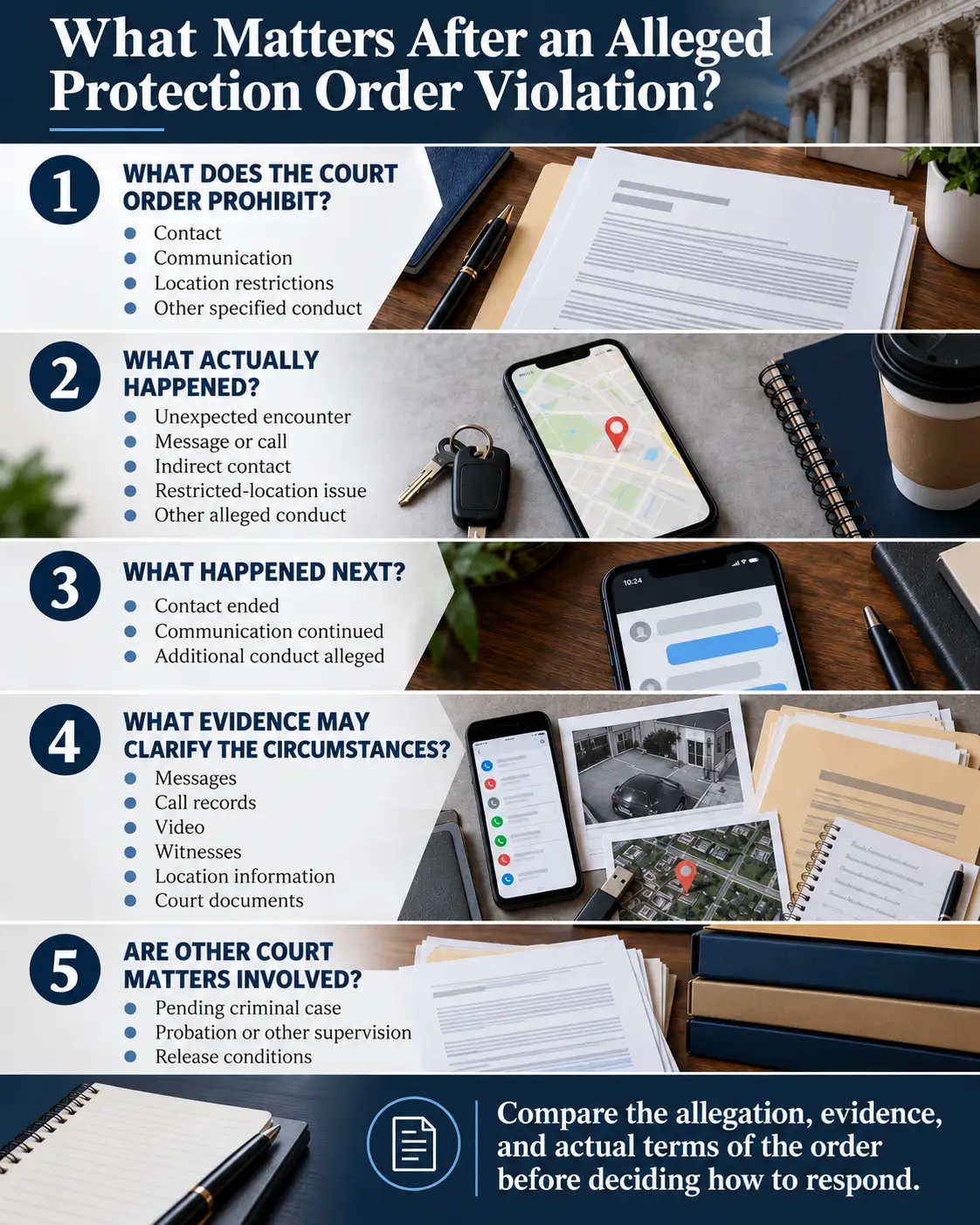
Messages, call records, video, witnesses, and location information may help establish what happened. Calling an encounter accidental does not automatically resolve the legal question.
What Should You Do After an Alleged Violation?
Trying to fix the situation directly can create more problems. Focus on complying with the order and preserving evidence.
|
Do:
|
Do not:
|
Keep evidence in its original form when possible. A complete record may provide context that an isolated screenshot does not.
Possible Defenses Depend on the Evidence
There is no single defense to every alleged domestic case violation. Relevant questions may include whether the conduct was prohibited, whether required knowledge can be established, whether identification is reliable, and whether the evidence proves the alleged contact.
Messages, video, witnesses, and other records may clarify whether an encounter was intentional, accidental, or different from what was initially reported.
How a Naperville Defense Lawyer Can Help After an Alleged Violation
A lawyer can review the order, police allegations, evidence, and release conditions to identify the immediate legal issues. The defense strategy may depend on what the order prohibits, what evidence exists, and whether another criminal matter is involved.
John W. Callahan has more than 30 years of legal experience. Our criminal defense attorneys can assess the allegations and evidence while helping clients understand the restrictions they must follow as the case moves forward.
Know What the Order Requires Before You Respond
An alleged Protection Order violation can turn on the order’s exact restrictions, what happened, and the evidence surrounding the contact. Before responding to the allegation or making further contact, those details need to be examined together.
Our Naperville defense team can evaluate those issues and identify what may matter in your case. Have your Protection Order case reviewed so you can make your next decision with the order and allegation clearly understood.